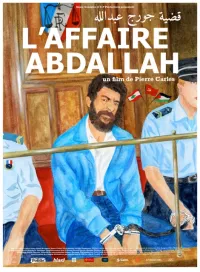
The Abdallah Case (L'Affaire Abdallah) (2026)
Origin: France | Documentary | Director: Pierre Carles | 101 minutes
The Abdallah Case (L'Affaire Abdallah)
“This is the first time people from outside have come into my cell.” The film opens in old Georges’s 9-square-metre cell: Rima Hassan has come to visit him on 14 February 2025. They embrace, deeply moved.
Moving back and forth through time and space between the Lannemezan prison in south-west France, Lebanon—the target of the Israeli invasions of 1978 and 1982—and the wave of attacks that shook France in the 1980s, Pierre Carles pieces together the story of a man who was talked about more than he spoke himself.
The documentary then delves into the intricacies of the media and political coverage of the case in the 1980s, when Abdallah’s name was a regular feature in the news. Pierre Carles, a documentary filmmaker critical of the media, lays bare the media’s fabrication of lies and interviews numerous key figures from that era.
The fact is, there had to be something to say to the French public, who were reeling from the Paris attacks, particularly the one on Rue de Rennes in 1986 (which left 7 dead and 55 injured), in the Montparnasse district. By that date, Georges Abdallah had already been behind bars for two years for possession of a false passport. He was paying the price for the assassination of two diplomats – an Israeli and an American – committed and claimed by the Lebanese Armed Revolutionary Faction (FARL), of which he was a member. His famous statement before the judges summed up his defence:
'Even if the people have not bestowed upon me the honour of taking part in the anti-imperialist actions you attribute to me, I at least have the honour of being accused of them by your court and of defending their legitimacy in the face of the criminal legitimacy of the executioners.'
The ‘Abdallah clan’, a media fabrication;
As for the indiscriminate attacks that have slaughtered civilians in Paris, Georges Abdallah and the FARL have nothing to do with them. His ‘clan’ is therefore blamed to avoid raising the issue of Iran, which is likely behind the attacks, after France supplied Super Étendard aircraft to Saddam Hussein during the Iran-Iraq War (1980–1988).
This distant war into which the French government had plunged the country by backing one of the sides found its echo in Paris. It was difficult to explain and to come to terms with. The culprits were easy to identify: the FARL, who were demanding the release of Georges Ibrahim, and the ‘Abdallah clan’, a catchphrase coined by Edwy Plenel
It is tempting to point the finger at scapegoats, mindlessly parroting the police’s line. Among the archive footage collected by Pierre Carles is this impromptu press conference organised by Georges Ibrahim’s two brothers in their living room to deny any involvement.
Then came that long ordeal of four decades in detention in the ‘dungeons of the Republic’, and the determination of those who campaigned tirelessly for his release. Tireless activists brandish his portrait at every demonstration. Every year they gather outside Lannemezan prison, where he had become France’s longest-serving political prisoner, to demand his release. But this was without reckoning with US interference and the pressure exerted on France, which ultimately thwarted the numerous appeals.
The political figures Pierre Carles features in his film do not come across particularly well: Manuel Valls “did not feel” he was under pressure; Éric Dupont-Moretti invokes the duty of discretion imposed by his status as a minister; and Laurent Fabius cites “early-onset Alzheimer’s”: he cannot even remember Abdallah’s name! Cornered by one of Pierre Carles’ assistants at a book fair, François Hollande admits that Hillary Clinton’s emails and various forms of pressure from the United States “played a part” in the repeated refusals to release Georges Abdallah.
French persecution
Released at the age of 74 and deported to his home country, Lebanon, on 25 July 2025, Abdallah continues to be the target of French persecution, directed not only against him personally but also, no doubt, against everything he stands for. In early March 2026, shortly after being elected mayor of Grenay, in the Pas-de-Calais (northern France), National Rally (RN) mayor Daisy Duveau had a plaque removed that had designated the activist as an honorary citizen of the town. A month later, the Court of Cassation revoked Georges Abdallah’s parole, arguing that it “cannot be granted until the convicted person has been placed under a regime of day release, external placement or electronic tagging for a period of at least one year”. A purely technical decision, as the man had been released and had, since the end of July, resettled in his home village of Kobayat, in northern Lebanon.
(Translation from: https://orientxxi.info/L-Affaire-Abdallah-Retour-sur-un-acharnement-judiciaire-et-politique)
View trailer